You found it behind the storage bins in the basement. A fuzzy gray-green patch on the bottom of the drywall, maybe a few black freckles climbing the wall above it. You did what millions of people do every month: typed “does vinegar kill mold” into your phone, filled a spray bottle from the pantry, and went to war.
A week later, the spot looks better. A month later, it’s back. And the basement still smells like a basement.
Here’s the thing almost nobody says plainly: killing mold and removing mold are two different jobs. A spray bottle, filled with anything, only ever attempts the first one.
The Short Answer: Does Vinegar Kill Mold?
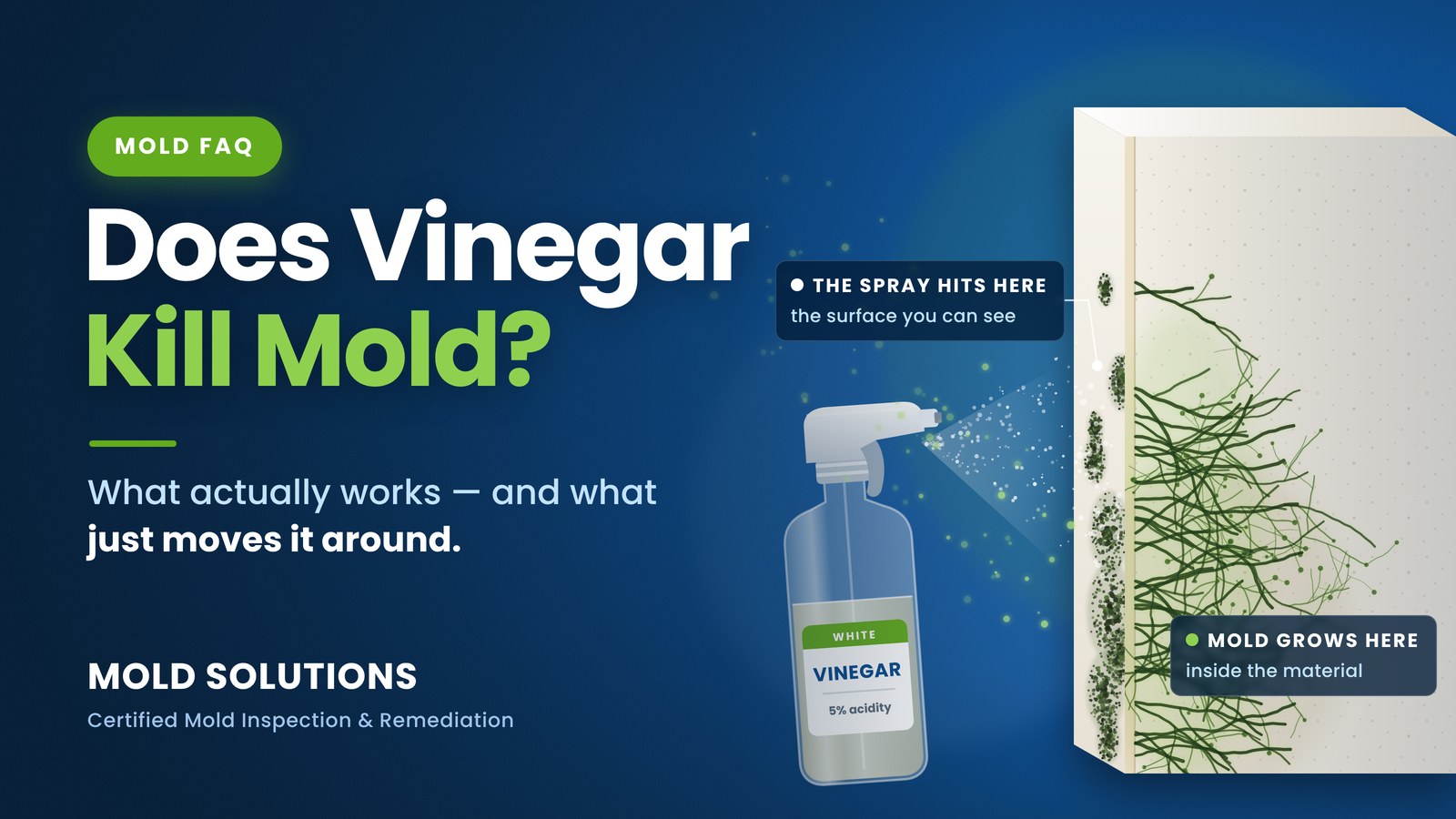
Sometimes, on some molds, on hard surfaces. Plain white vinegar (about 4–5% acetic acid) is mildly antifungal. It can knock back light mildew on tile, glass or a shower curtain. It is not a reliable mold killer, and it does nothing about mold that has grown into a porous material like drywall, carpet or ceiling tile.
The best independent test we’ve found makes the point. Researchers at the University of Adelaide and Flinders University tested common antifungal treatments in 2015, including household vinegar at 4.0–4.2% acetic acid. Vinegar inhibited one common indoor mold (Penicillium chrysogenum) and had no effect at all on another (Aspergillus fumigatus). The authors concluded vinegar “may not be effective against the diverse fungal genera” found indoors, and that because it doesn’t persist on surfaces, its use may be limited to non-porous materials.
That was in a lab dish. A basement wall is harder.
And even when vinegar does kill mold, the EPA is blunt about what that buys you: “it is not enough to simply kill the mold, it must also be removed,” because “dead mold may still cause allergic reactions in some people.”
Vinegar vs. Bleach vs. Peroxide vs. Lysol: The Honest Scorecard
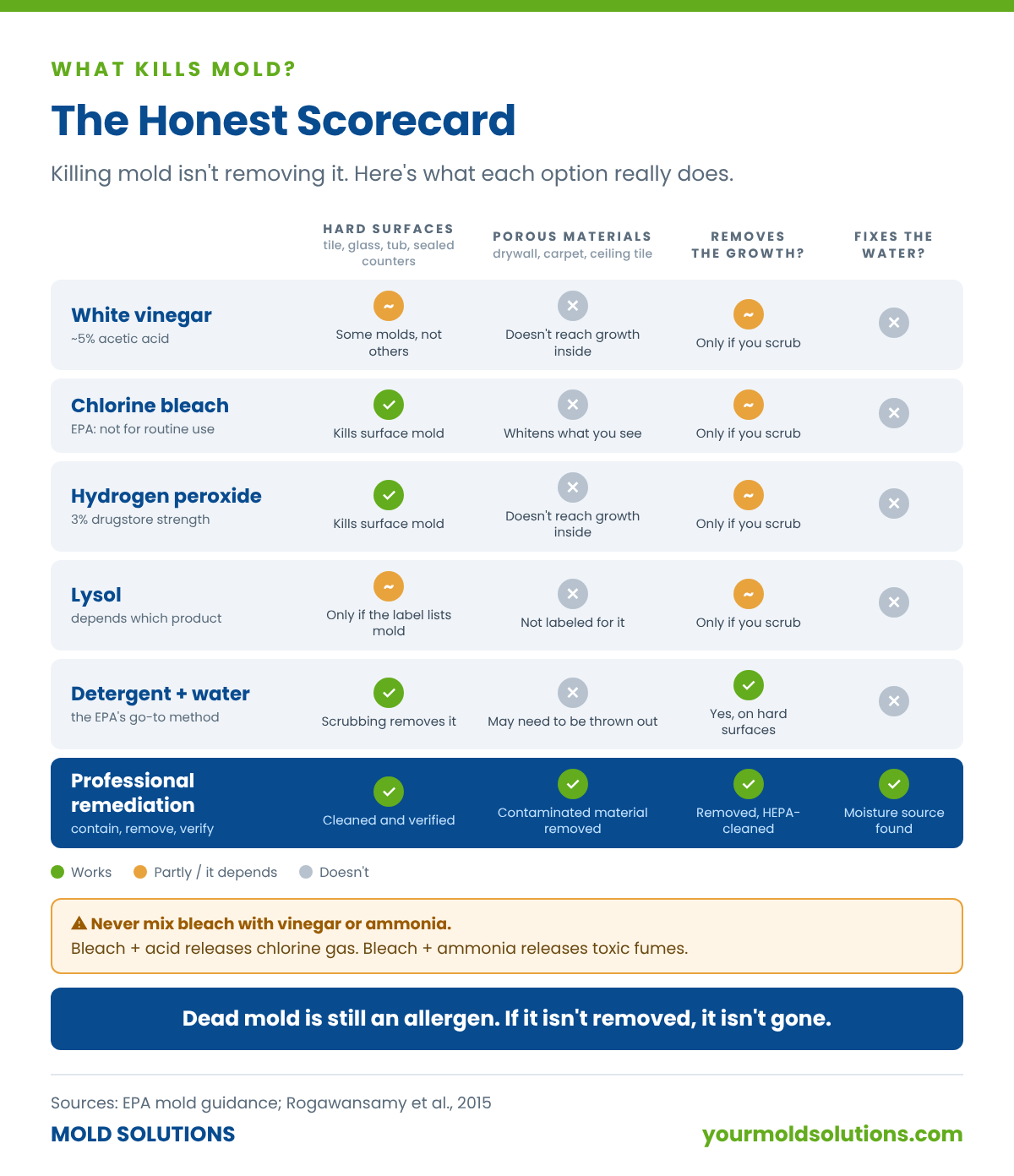
Every product on the cleaning aisle gets compared on one question: does it kill mold? That’s the wrong question. The useful questions are: does it work on the surface you actually have, does it remove the growth, and does it do anything about the water that caused it? (None of them do that last one.)
Does bleach kill mold?
On a hard, non-porous surface like tile or a tub, chlorine bleach does kill surface mold and takes the stain with it. That’s why it feels like it works.
But the EPA says using bleach or any other biocide “is not recommended as a routine practice during mold cleanup.” Its reasoning is the same as above: total sterilization isn’t realistic, some spores always remain, and dead mold still needs to come off the surface. On drywall, wood or anything soft, bleach whitens what you can see without dealing with what’s inside the material.
And never, ever mix bleach with vinegar. Bleach plus any acid (vinegar included) releases chlorine gas. Bleach plus ammonia-based cleaners releases toxic chloramine fumes. The EPA’s instruction is simple: never mix chlorine bleach with other cleaning products. If you’ve used one, rinse and ventilate before you even think about the other.
Does hydrogen peroxide kill mold?
Drugstore hydrogen peroxide (3%) is an oxidizer, and it can kill mold on hard surfaces. It has the same limits as everything else in this list. It doesn’t remove the dead growth, it doesn’t reach into porous materials, and it can lighten fabrics and some finishes, so test a hidden spot first. Better than vinegar on a tough day, not a different category of answer.
Does Lysol kill mold?
It depends on which Lysol. The standard Lysol Disinfectant Spray is labeled for viruses and bacteria, and its product page makes no mold claims. Lysol’s Mold & Mildew Remover is a different product, and it’s bleach-based, so everything in the bleach section applies (including the never-mix rule). Read the label, not the brand name. If the label doesn’t list mold or mildew and the surface you’re using it on, it isn’t a mold product.
What kills black mold?
“Black mold” sounds like one specific villain. In practice, many molds are dark, and color alone can’t tell you which species you’re looking at. Only a lab can. The good news is that it doesn’t change the plan: the cleanup rules are the same no matter what color it is. Hard surface, small area, scrub and dry. Porous material or a large area, it comes out. The scarier the name, the less it should push you toward a spray bottle.
What kills mold on wood?
This one comes up constantly in Midwest basements and crawl spaces, where framing lumber and subfloor take the brunt of summer humidity. Wood sits in the middle: it’s not as hopeless as drywall, but it’s not tile either. In its remediation guidance, the EPA treats small and medium areas of moldy wood as cleanable (wet vacuum, damp wipe, then HEPA vacuuming once it’s dry), and large areas as candidates for removal. The step that matters most isn’t the product. It’s getting the wood dry, and keeping it dry. Wood that stays damp will grow mold again whatever you sprayed on it.
Why Spraying Mold Often Just Moves It Around
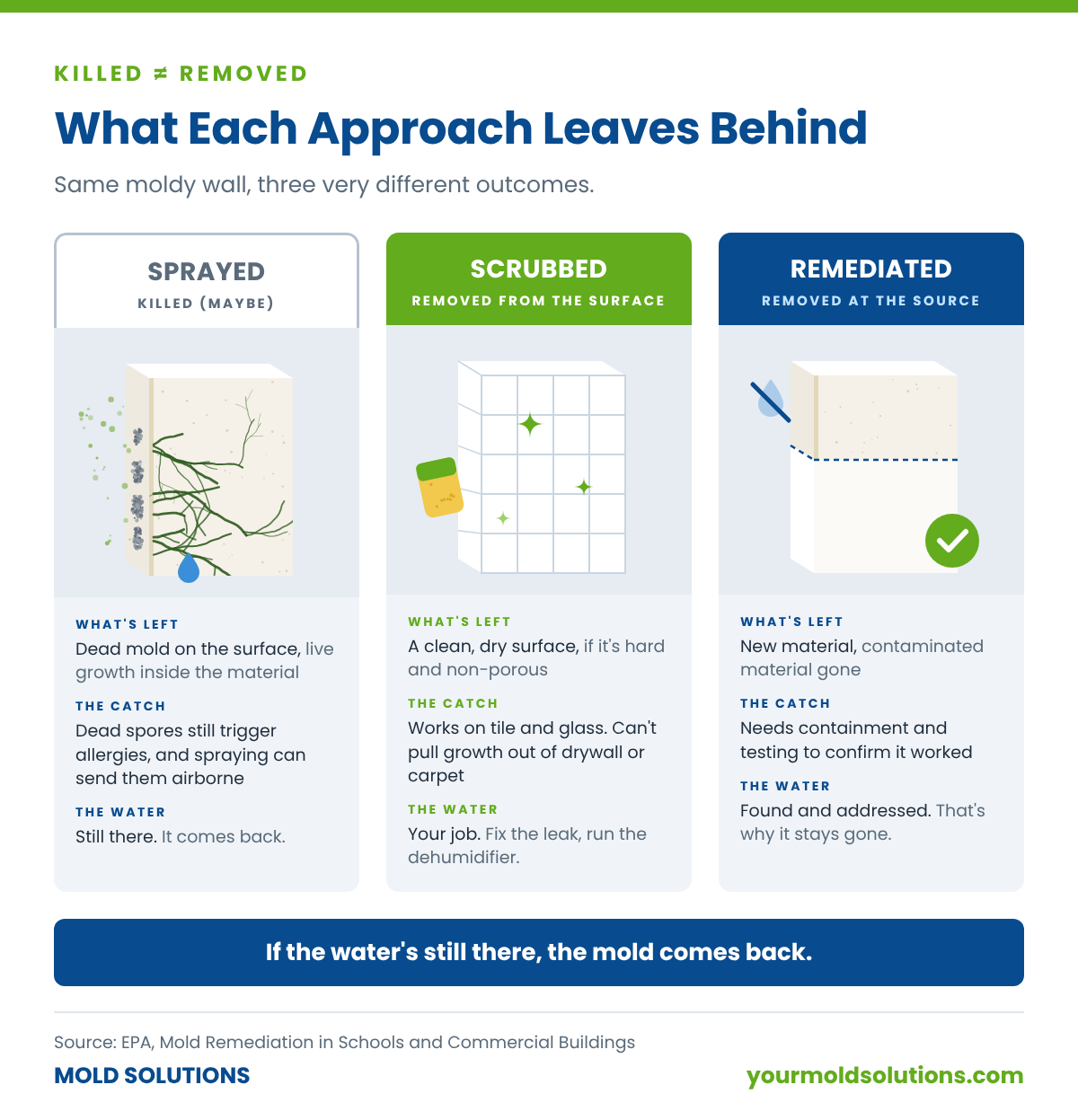
This is the part of the story most “vinegar hack” articles skip. A spray-and-wipe approach doesn’t just fall short. In a few specific ways, it can make things worse.
1. Dead mold is still mold. The EPA’s commercial remediation guidance says it outright: “Dead mold is still allergenic, and some dead molds are potentially toxic.” A wall of dead spores is not a clean wall.
2. Disturbing dry mold puts it in the air. Mold is built to spread through spores. Spraying, scrubbing and especially wiping with a dry rag can launch them. In the EPA’s words, if cleanup “disturbs mold and mold spores become airborne, then the risk of respiratory exposure goes up.” Then your furnace blower helpfully carries them to every room.
3. You’re adding water to a water problem. Vinegar is 95% water. Soaking a porous surface that’s already growing mold, then walking away without drying it, feeds the next round.
4. Porous materials can’t be scrubbed clean. Drywall paper, carpet pad, ceiling tile and insulation give mold a place to grow into, not just onto. The EPA says absorbent or porous materials “may have to be thrown away if they become moldy.” (We wrote a whole post on whether moldy insulation can be cleaned.)
5. The water source is still there. A slow foundation seep, a sweating duct, a dryer vent dumping into the crawl space, a basement that sits at 70% humidity all August. Spraying the mold treats the symptom and leaves the cause untouched. That’s why the spot comes back in the same place.
6. Paint hides it, briefly. “Mold-resistant paint” over existing growth is a cover-up, not a fix. The EPA’s advice: “Do not paint or caulk moldy surfaces.”
What Actually Works (for Small Spots You Can Handle Yourself)
If the area is small (the EPA’s rule of thumb is less than about 10 square feet, roughly a 3-by-3 patch), it’s on a hard surface, and nobody in the house has asthma or a weakened immune system, you can usually handle it. Do it in this order:
- Fix the water first. Find the leak, the condensation or the humidity source. If you skip this step, everything else is temporary. Get a $12 hygrometer and keep indoor humidity below 60%, ideally 30–50%, per the EPA.
- Protect yourself. The EPA recommends an N-95 respirator, gloves and goggles. Ventilate the room, and close the door to the rest of the house.
- Scrub, don’t spray. The EPA’s method for hard surfaces is about as unglamorous as it gets: detergent and water. The scrubbing is what removes the growth. Use a disposable cloth or sponge and bag it when you’re done.
- Dry it completely. Fans, a dehumidifier, open windows if the air outside is drier. Within 24–48 hours is the goal.
- Throw out what can’t be cleaned. Moldy cardboard boxes, ceiling tiles, carpet pad and stained drywall paper go out in sealed bags. Don’t try to rescue them.
- Watch it for a month. If it comes back in the same spot, the moisture source is still there.
Prefer vinegar because it’s what you have? On a hard surface, it’s fine as the cleaning liquid, as long as you scrub, wipe it off and dry the area. Just don’t count on it to do the scrubbing for you.
When It’s Bigger Than a Spray Bottle
Mold is a remediation job, not a cleaning job, when:
- It covers more than about 10 square feet, or keeps coming back after you’ve cleaned it
- It’s on or in drywall, carpet, ceiling tile, insulation or subfloor
- You smell it but can’t see it (a strong musty smell usually means there’s growth somewhere you can’t reach; here’s how to track down a musty smell)
- It followed a flood, sewer backup or long-running leak
- It’s in your HVAC system or ductwork
- Someone in the house has asthma, allergies or a weakened immune system
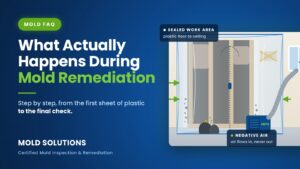
Professional remediation looks nothing like a spray bottle. It means finding and fixing the moisture source, setting up containment and negative air pressure so spores don’t travel, physically removing contaminated materials, HEPA-vacuuming what’s left, and verifying the result with post-remediation testing, not just a sniff test. If you’re wondering what that costs, we broke down what mold remediation actually costs in Chicagoland and St. Louis. And before you buy a store kit to “confirm” what you’re seeing, read why a mold test kit can mislead you.
At Mold Solutions, we’ll tell you honestly which situation you’re in. If it’s a small spot on a tile wall, we’ll tell you to grab a scrub brush. If it’s growing inside the wall, we’ll show you where and why. Not sure? Take our 2-minute mold assessment first.
Chicagoland: Call 815-469-8877
St. Louis: Call 314-993-6653
Or schedule your inspection online, and put the spray bottle back in the pantry.
Further reading: Should You Remove Moldy Insulation or Try to Clean It? · What Mold Remediation Actually Costs in Chicagoland and St. Louis
Sources: EPA — A Brief Guide to Mold, Moisture and Your Home · EPA — Should I Use Bleach to Clean Up Mold? · EPA — Mold Remediation in Schools and Commercial Buildings · Rogawansamy et al. (2015), An Evaluation of Antifungal Agents for the Treatment of Fungal Contamination in Indoor Air Environments · Healthline — Bleach and Vinegar